
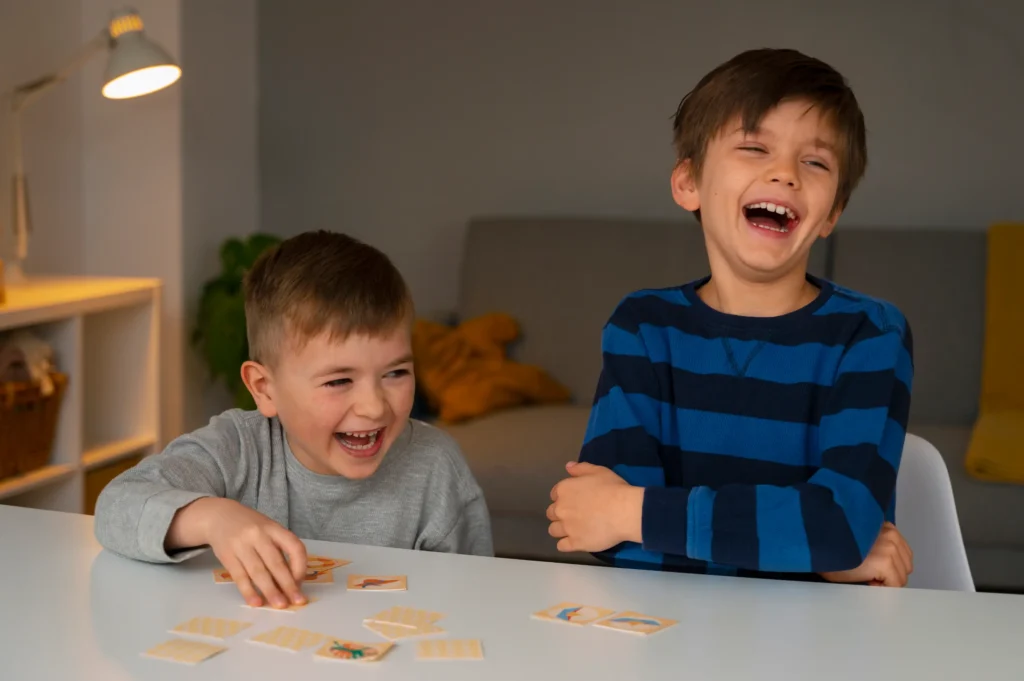
Teaching kids about money doesn’t have to feel like a dry academic lesson. Everyday games can introduce budgeting, saving, spending, and problem-solving in ways that feel fun, tactile, and completely natural instead of overwhelming.
At MoneyKids, we believe that children learn best when they are actively doing, playing, and making decisions. This guide shares 30 practical money games you can play at home with your children, grouped by the critical life skills they teach. Each activity uses simple everyday household items and encourages positive family conversations that help kids understand how money really works in the real world.
Budgeting & Grocery Shopping Games for Kids
Budgeting games help kids understand that every financial purchase involves choices, priorities, and trade-offs. Grocery shopping naturally introduces these lessons because children can compare prices, work within a fixed budget, and decide which items offer the true value. Instead of memorizing abstract money terms, they begin applying them during everyday decisions.
These activities also create perfect opportunities to talk about family spending in a relaxed, stress-free setting. As parents, you can explain why one product is chosen over another, how discounts affect the final price, or why staying within a budget sometimes means putting a desired item back on the shelf. The goal isn’t necessarily finding the cheapest option every time; it’s helping children think critically before they spend.
Most of these games work beautifully with supermarket flyers, online grocery listings, or homemade price tags. They can also be adapted for different ages by adjusting the budget limits or adding extra challenges such as calculating discounts or comparing unit prices.
1. The $20 Challenge
The $20 Challenge teaches kids how to plan within a fixed budget while deciding what they need—and want—most. Give your child a supermarket flyer or browse an online grocery store together, then set a budget of $20 for a themed event like a family movie night, picnic, or taco dinner.
As they choose items, encourage them to compare prices and decide which purchases deserve space in their budget. They may swap branded snacks for store brands or skip an extra treat to stay within their limit. When they’re finished, ask why they made each decision and whether they would spend differently if they had a slightly different budget.
2. Shopping Relay
Shopping Relay helps kids compare prices before making a purchase. Label household items with printed prices or use products from your pantry, then call out a spending challenge such as “Find three items for under $10” or “Choose the healthiest snack for less than $5.”
Players race to assemble their selections while staying within budget. After each round, review everyone’s choices together. Discuss which shopper found the best value and why. This encourages children to slow down and evaluate purchases instead of grabbing the first option they see on a shelf.
3. Discount Dash
Discount Dash teaches kids how coupons and sales change the final price of a purchase. Create two shopping baskets filled with everyday products and attach different discounts, such as percentage-off coupons, dollar savings, or buy-one-get-one offers.
Kids calculate the total cost of each basket before deciding which deal saves the most money. As they work through the calculations, explain that the biggest-looking discount isn’t always the best value. Older children can compare unit prices or calculate percentage savings, while younger kids can practice simple subtraction using whole-dollar amounts.
4. Meal Planner Game
The Meal Planner Game shows kids how families balance nutrition, preferences, and spending at the same time. Give your child a spending limit and ask them to plan dinner using ingredient prices from a grocery website or weekly supermarket flyer.
Once they have chosen their ingredients, invite them to explain why they picked each item. They might choose frozen vegetables because they cost less, replace expensive meat with beans, or skip dessert to stay within budget. The activity naturally introduces conversations about planning ahead, avoiding food waste, and making thoughtful spending decisions during everyday shopping.
5. Mystery Shopper
Mystery Shopper encourages kids to think about value instead of buying the first thing they see. Write simple shopping missions on cards, then let your child solve one challenge at a time. Examples include finding the healthiest breakfast under a certain price, choosing the best bulk-buy option, or picking a birthday gift within a budget.
After completing each mission, ask them to explain their thinking. They may compare serving sizes, quality, or overall usefulness before deciding. This habit of explaining their choices helps children recognize that smart shopping involves asking questions, comparing options, and spending with a purpose instead of simply looking at the price tag.
Financial Decision-Making & Priority Games
Financial decision-making games help kids understand that every spending choice has an opportunity cost: when you choose one thing, you are giving up something else. As children grow, they’ll face decisions about saving, spending, sharing, and waiting for something bigger. These activities introduce concepts like delayed gratification and responsible allocation through everyday situations they can relate to, helping them build lifelong money habits early.
6. Spend, Save, Give, Invest Cards
Spend, Save, Give, Invest Cards teach kids that money can serve different purposes instead of being spent all at once. Prepare scenario cards with examples such as earning money from chores, receiving birthday cash, or selling homemade crafts. Place four jars or containers on the table labeled Spend, Save, Give, and Invest.
Each player draws a card and decides how to divide the money among the four jars. There isn’t a single right answer. What matters is being able to explain each choice. One child might save for a new bike, while another chooses to donate part of the money to charity. These conversations help children understand that financial priorities vary from person to person and depend heavily on individual goals.
7. Money Scenario Cards
Money Scenario Cards help kids practice solving everyday financial problems before they encounter them in real life. Write simple situations on index cards, then discuss how each one could be handled. For example, a child might have saved money for a toy but suddenly need to replace a broken backpack, or choose between buying candy today and saving for a video game next month.
Rather than rushing to give them the answer, encourage children to think about what happens immediately and what happens later. This introduces the idea that every financial decision affects future choices. As kids become older, parents can make the scenarios more realistic by including part-time jobs, allowances, or unexpected expenses.
8. Good Deal or Bad Deal?
Good Deal or Bad Deal teaches kids to look beyond flashy promotions before deciding what offers the best value. Create pairs of common retail promotions using printed advertisements or homemade price cards. Compare offers like “Buy One Get One 50% Off” against “30% Off Everything,” or compare different package sizes with different prices.
Ask children to calculate which option saves the most money and explain how they reached their answer. Once they’ve finished, discuss why stores use different promotions and how advertisements are designed to attract attention. The activity builds a healthy consumer skepticism while helping kids recognize that bigger signs don’t always mean bigger savings.
9. Needs, Wants, or Wishes
Needs, Wants, or Wishes teaches kids how to prioritize spending based on importance instead of impulse. Prepare pictures of everyday items, experiences, and larger goals, then ask children to sort each one into three categories.
A winter jacket might belong under “Need,” a new toy under “Want,” and a family vacation under “Wish.” Some answers may spark debate, and that’s part of the learning. Parents can ask why a child placed an item in a certain category and explore how different families may prioritize spending differently. The game encourages thoughtful conversations while helping children understand that not every desire requires an immediate purchase.
10. Would You Buy It?
Would You Buy It encourages kids to think critically before spending money on something simply because it looks exciting. Show photos of unusual gadgets, novelty products, or expensive toys, then reveal the price without giving your opinion.
Ask children whether they would buy the item and, more importantly, why. Does it solve a real problem? Will it still be useful a month later? Could that money be spent on something with greater value? There are no winners or losers in this game. Instead, children practice evaluating usefulness, comparing alternatives, and resisting the urge to buy something simply because it’s new or popular. These conversations build strong decision-making skills they’ll use long after childhood.
Pretend Play Entrepreneurship & Business Games
At MoneyKids, we treat entrepreneurship not just as the act of starting a business, but as a crucial mindset centered on creativity, initiative, collaboration, and resilience.
Running a pretend business introduces financial concepts that go beyond standard spending and saving. Children learn that every product has real production costs, that pricing directly affects sales, and that profit is what remains only after all expenses are paid. These activities are also exceptional for building teamwork, leadership, and public speaking skills.
11. Lemonade Stand Simulator
A Lemonade Stand Simulator teaches kids how businesses balance costs, pricing, and profit. Give your child a small amount of play money to “buy” ingredients such as lemons, sugar, cups, and ice before opening their stand. Once they’ve calculated their startup costs, ask them to decide how much to charge for each cup.
To keep the game interesting, introduce surprise events throughout the day. A sunny afternoon might attract extra customers, while a rainy forecast could reduce sales. You can also add challenges like rising ingredient costs or a nearby competitor offering lower prices. At the end of the game, help your child calculate total revenue, subtract expenses, and determine whether they made a profit.
12. Shark Tank for Kids
Shark Tank for Kids teaches children how entrepreneurs turn ideas into reality by convincing others to back them. Invite kids to create a product using household or recycled materials, then present their invention to parents or siblings acting as investors.
During the presentation, encourage them to explain what problem their product solves, who would buy it, and how they plan to earn money. Investors can ask simple questions before deciding whether to offer play money in exchange for a share of the business. The activity encourages creative thinking while introducing concepts such as investment, ownership, and negotiation in a way that’s easy to understand.
13. Advertising Challenge
The Advertising Challenge shows kids how marketing influences buying decisions. Give every player the same everyday object, such as a mug, notebook, or reusable water bottle, then challenge them to create the most convincing advertisement.
They can design a poster, write a catchy slogan, or perform a short commercial highlighting the product’s unique benefits. Once everyone has presented, family members vote on which advertisement made the product the most appealing. Afterwards, discuss how advertisements focus on solving problems or making products feel desirable. It’s a simple way to help children recognize how marketing shapes consumer choices.
14. Business Startup Game
The Business Startup Game teaches kids that starting a business requires planning before earning any income. Give each player the same amount of play money as their startup budget, then present a list of operational expenses such as inventory, equipment, signs, decorations, and packaging.
Children decide how to divide their budget before their business opens. Some may spend heavily on products, while others invest in making their storefront look attractive. As the game progresses, parents can introduce different customer preferences to show how early decisions affect later results. By the end, kids begin seeing that successful businesses rely on thoughtful planning, not simply having the biggest budget.
15. Profit Race
Profit Race helps kids discover that the highest price doesn’t always lead to the highest profit. Choose a simple product, such as handmade bookmarks or paper airplanes, and let children experiment with different selling prices over several rounds.
For example, selling at a low price may attract many customers but generate little profit per sale. Charging too much may result in very few buyers. After each round, compare total sales, expenses, and final profit together. The activity introduces one of the most valuable business lessons: finding a price that balances customer demand with sustainable earnings. Kids quickly learn that running a successful venture involves testing ideas, listening to customers, and adjusting their strategy over time.
Kinetic Cash & Coin Math Games
Counting coins, making exact change, and recognizing different denominations are easier to learn when children can touch, sort, and use money in active, physical games. These kinetic activities combine body movement with quick thinking, helping younger learners stay highly engaged while building confidence.
Parents can use play money, real coins under close supervision, or printable currency depending on the child’s age. As children become more confident, increase the difficulty by adding larger amounts.
16. Coin Toss Score
Coin Toss Score helps kids recognize coin values while practicing mental addition. Place plastic cups or bowls around the room and assign each one a different value, such as 5 cents, 10 cents, 25 cents, or $1. Players take turns tossing coins into the targets, then add up the value of the coins they successfully landed.
Once everyone has finished, compare totals together and ask children to explain how they calculated their score. Younger kids can count one coin at a time, while older children can practice grouping values to add faster. The game blends movement with simple math, making coin recognition feel like an exciting challenge.
17. Money Target Practice
Money Target Practice teaches kids how different financial goals compete for the same money. Create a target on the floor using tape, paper, or cardboard, then divide it into sections labeled with goals such as “Savings,” “Charity,” “Emergency Fund,” or different dollar amounts.
Players slide or gently toss coins toward the targets, earning points based on where the coins land. After each round, talk about why someone might choose to put money into savings instead of spending it right away. The game encourages conversations about financial priorities while giving children another chance to practice identifying different coins.
18. Coin Combination Challenge
The Coin Combination Challenge teaches kids that the same amount of money can be made in many different ways. Pick a target value, such as $1.00 or 50 cents, then challenge players to create as many unique combinations of coins as possible.
For example, one dollar could be made with four quarters, ten dimes, or a mix of quarters, dimes, nickels, and pennies. As children discover new combinations, ask them to explain their thinking aloud. This strengthens flexible mathematical thinking and prepares them for making change during everyday purchases.
19. Fastest Exact Change
Fastest Exact Change helps kids count money accurately while improving speed and confidence. Call out an amount such as $4.63 or $2.85, then ask players to build that value using the fewest bills and coins possible.
After each round, compare everyone’s answers together. If two players arrive at the same amount using different combinations, discuss which solution uses fewer pieces of money and why cashiers often count change in an efficient order. This activity becomes increasingly challenging as children grow comfortable working with larger numbers.
20. Hidden Price Game
The Hidden Price Game encourages kids to estimate prices by thinking about value instead of guessing randomly. Choose a household item or toy and let everyone study it for a few moments. Without revealing its retail price, ask each player to build what they think the item costs using coins, bills, or play money hidden behind a book or small box.
Once everyone is ready, reveal the guesses alongside the item’s actual price. Talk about what influenced each estimate. Was it the item’s size, brand, quality, or how often it gets used? Over time, children become better at judging value, comparing prices, and understanding that expensive items aren’t always the best choice.
Homemade Financial Board & Card Games
Unlike one-time activities, these games can be played again and again, giving children plenty of opportunities to strengthen their understanding of money concepts. They also encourage discussion, teamwork, and strategic thinking, making them a great choice for family game nights or rainy afternoons.
Most of these games only require index cards, paper, markers, dice, or a simple printable game board. Parents can easily adjust the questions or rules as their children grow. Younger kids can focus on recognizing coins and basic spending decisions, while older children can tackle topics like investing, interest, taxes, and budgeting.
21. Money Jeopardy
Money Jeopardy helps kids build financial vocabulary while encouraging quick thinking. Create a simple game board with categories such as Earning, Saving, Spending, Banking, and Investing. Under each category, write questions worth different point values based on their difficulty.
Players choose a category and point value before answering the question. Younger children might identify the purpose of a piggy bank, while older kids explain how compound interest helps savings grow over time. Parents can adjust the questions to match their child’s age, making the game enjoyable for the whole family.
22. Financial Trivia Quiz
A Financial Trivia Quiz helps kids strengthen their money knowledge by answering short, engaging questions. Prepare a stack of trivia cards covering everyday topics like identifying different coins, understanding debit cards, recognizing famous people on banknotes, or explaining simple banking terms.
Keep the pace quick so players stay engaged, and encourage discussion whenever someone gives an unexpected answer. If a question sparks curiosity, take a moment to explore it together before moving on. This turns the game into both a quiz and an open conversation about how money works in everyday life.
23. Money Escape Room
A Money Escape Room combines financial problem-solving with teamwork and critical thinking. Hide a small prize inside a locked box or sealed container, then create a series of money-themed puzzles that reveal the code or key one step at a time.
Children may need to fix a budgeting mistake, count exact change, solve a shopping puzzle, or decode a savings challenge before moving to the next clue. Each puzzle builds on the previous one, encouraging players to communicate and think carefully under a fun time limit. The excitement of unlocking the final prize keeps children motivated from beginning to end.
24. Roll-to-Riches
Roll-to-Riches teaches kids that financial situations can change unexpectedly, making planning an important habit. Draw a simple board game where each square represents a life event. Players move around the board by rolling dice, collecting income, paying bills, making donations, or dealing with surprise expenses.
One turn might reward players with extra allowance, while the next requires paying for a broken bicycle or replacing a lost backpack. As children continue playing, they begin seeing why having a savings buffer can make unexpected situations easier to handle. The game also introduces the idea that financial success often depends on making steady decisions over time rather than relying on luck.
25. Financial Bingo
Financial Bingo helps kids become familiar with common money terms in a relaxed and interactive way. Instead of using numbers, fill each bingo card with financial words such as “Budget,” “Interest,” “Savings,” “Allowance,” or “Deposit.”
Read simple definitions or real-life examples aloud, and have players identify the matching term on their cards. For example, you might ask, “What do you call money you regularly set aside for future goals?” Players would then mark “Savings” if it’s on their board. By connecting definitions with familiar words, children gradually build confidence using financial vocabulary in everyday conversations.
Active & Movement-Based Money Games
Active money games combine physical movement with financial thinking, helping kids stay engaged while learning important money skills. For children who enjoy running, jumping, and solving challenges, these activities make financial literacy feel like an adventure instead of a lesson. Along the way, they practice budgeting, saving, planning, and decision-making through hands-on experiences that keep both their minds and bodies active.
Most of these games require very little preparation. Painter’s tape, paper signs, play money, and household objects are often enough to create an engaging activity. Parents can also increase the difficulty as children grow by introducing larger budgets, multi-step challenges, or unexpected financial events that encourage flexible thinking.
26. Budget Obstacle Course
A Budget Obstacle Course teaches kids that earning money often takes effort, and spending it requires thoughtful decisions. Set up simple physical challenges around the house, such as crawling under chairs, hopping between pillows, or balancing while carrying a small object. Each completed challenge earns a set amount of play money.
Once the course is finished, invite children to spend their earnings at a pretend store stocked with small prizes or treats. Include both inexpensive rewards and larger items that require saving. This naturally introduces delayed gratification as children decide whether to enjoy a small reward immediately or save for something they value even more.
27. Money Treasure Hunt
A Money Treasure Hunt helps kids practice financial math by solving clues that lead to the next location. Hide clues throughout your home, with each one containing a short money problem that players must answer before moving forward.
For example, a clue might ask, “If you save $2 every week for six weeks, how much money will you have?” The correct answer reveals where the next clue is hidden. Younger children can solve simple addition problems, while older kids tackle budgeting or percentage questions. The final clue can lead to a small prize, extra play money, or another family activity.
28. Price Tag Hunt
Price Tag Hunt encourages kids to think about how much everyday household items are worth. Write prices on sticky notes or detachable tags and hide them around a room. Players search for the tags, then match each one with the item they believe fits that value.
After everyone has finished, reveal the correct answers and talk about what influenced each estimate. Children often discover that an item’s size doesn’t always reflect its price, and that quality, materials, or brand can affect value. This simple activity helps build price awareness while encouraging thoughtful comparisons.
29. Race to Retirement
Race to Retirement introduces kids to long-term financial planning through a giant floor game. Create a path across the floor where each space represents a different stage of life. Along the journey, players encounter choices such as continuing their education, starting a career, saving for a home, investing money, or dealing with unexpected expenses.
Every decision affects their progress. Choosing to invest may lead to larger rewards later, while spending everything immediately could make future challenges harder. The game helps children understand that financial decisions made today can influence opportunities many years down the road.
30. Money Mission Wheel
Last but not least, Money Mission Wheel teaches kids how unexpected events can change a financial plan. Make a spinner using cardboard or paper and fill each section with different financial scenarios. Examples include receiving birthday money, paying an unexpected medical bill, earning a bonus for finishing chores, or donating to a charity.
Players spin the wheel and update a simple budget sheet after each turn. As new situations appear, they decide whether to spend, save, or adjust their plans. By the end of the game, children see that managing money isn’t about following a perfect, static plan. It’s about adapting when circumstances change while keeping long-term goals in mind.
Frequently Asked Questions About Teaching Kids Money
What age should you start teaching kids about money?
Children can begin learning simple money concepts as early as age 3. At this stage, they can recognize coins, count small amounts, and understand that money is exchanged for goods and services.
Research from the University of Cambridge suggests that many core financial habits begin developing by around age 7. This is why at MoneyKids, we design our interactive learning spaces specifically for children aged 7–12. It’s the perfect developmental window to move past basic counting and start introducing real-world financial principles.
For a structured roadmap on introducing money milestones at every stage of their growth, explore our Complete Parent Guide to Financial Literacy for Kids.
How do you make financial literacy fun for children?
The easiest way to make financial literacy fun is to completely step away from lectures and turn everyday lessons into games. Activities like running a lemonade stand, playing shopping simulators, or solving money treasure hunts give children opportunities to practice critical life skills without feeling like they’re in a classroom.
If you want to take their learning to the next level, our specialised Entrepreneur Bootcamp & Financial Literacy Bootcamp programs provide safe, collaborative environments where kids can pitch ideas, make business decisions, and run real-world simulations alongside other young peers.
What are the best free apps to teach kids about money?
Several free apps help children practice money management alongside hands-on activities at home. Popular options include Bankaroo, RoosterMoney, and Greenlight, which allow families to track allowances, savings goals, chores, and spending in age-appropriate ways. While apps are useful digital tools for reinforcing habits, they work best when paired with physical, offline play and regular real-world experiences.