
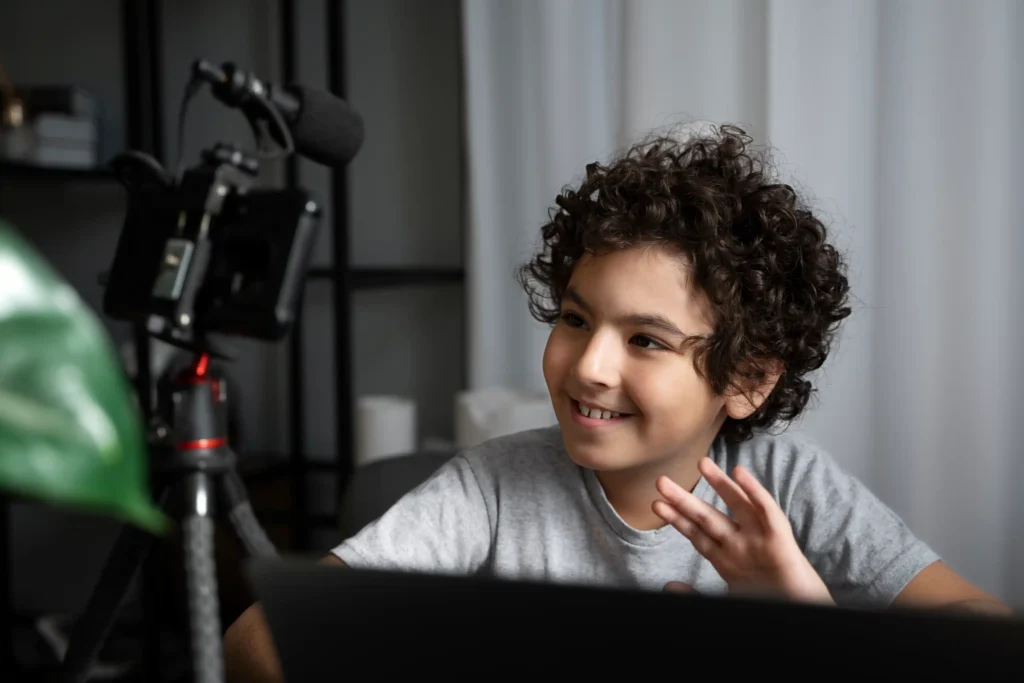
Public speaking can feel intimidating for adults, so it is no surprise that many children feel nervous when asked to speak in front of others. To help them overcome this, they will need playful practice, encouragement, and regular opportunities to express their ideas.
You can improve your child’s public speaking skills by giving them low-pressure opportunities to speak, listen, ask questions, tell stories, explain ideas, and present to familiar people.
Fun public speaking activities such as show and tell, storytelling games, mini debates, interviews, picture prompts, and pretend business pitches can help children build confidence and become more comfortable in front of an audience.
If you’re looking for more ways to build these skills at home, here are 11 ways to teach kids public speaking.
This guide shares seven fun public speaking activities and games for kids that parents and teachers can try at home or in the classroom to help hone the skill even further.
Why Kids Should Learn Public Speaking
Children use speaking skills in all kinds of everyday situations, from answering questions in class and introducing themselves to explaining a school project, sharing an opinion, telling a story, or asking for help.
Being able to express an idea clearly can make them feel more capable at school and in social situations. And it will certainly be of great help in their adult life, especially when entering professional environments.
That is why public speaking games for children can be so helpful to hone the skill early on.
How to Improve Public Speaking Skills in Kids
Start with three simple principles: practise often, keep it playful, and celebrate progress.
Children are more likely to improve when speaking becomes a normal part of their routine rather than something they only do when they have a presentation at school. A child might explain how they solved a puzzle, tell the family about their day, present a favourite toy, or pitch a creative idea over dinner.
It also helps to start small. Let them speak to a parent or sibling before asking them to address a larger group. Keep early speaking sessions short, model good habits such as pausing and making eye contact, and focus on one skill at a time. Most importantly, praise the effort rather than expecting perfection.
1. Mystery Object Show and Tell
Show and tell is one of the classic public speaking activities for kids, and adding a mystery element makes it a little more exciting.
Ask your child to choose an object from around the house or classroom and hide it in a bag or box. It could be a toy, book, or anything else they find interesting.
Let the child give three to five clues without saying what it is. Once everyone has had a chance to guess, they reveal the object and give a short talk about it.
They might explain why they chose it, where it came from, how they use it, or whether they have a special memory connected to it. Younger children can speak for around 30 seconds, while older children can try for two or three minutes.
The object gives children something familiar to talk about, which makes this a good starting point for nervous speakers. At the same time, they practise descriptive language, organising their thoughts, speaking clearly, and answering follow-up questions.
Make It More Fun
You can give each round a theme, such as “something that makes you smile,” “something you would take on an adventure,” or “something that could become an invention.”
For an extra challenge, let the audience vote on categories such as the best clues, most surprising object, or most creative explanation. Keep the voting light-hearted so the activity remains about having fun rather than winning.
Parent or Teacher Tip
Try not to give a long list of corrections after the activity. Pick one thing the child did well and one small thing they could try next time.
For example: “You gave really clear clues. Next time, try looking up at the audience after each clue.”
That makes feedback easier to absorb and helps children associate public speaking with encouragement.
2. Story Circle Challenge
Children naturally enjoy stories, which makes storytelling a great way to practise public speaking.
Gather everyone in a circle and have one person begin a story with a single sentence. It could be something simple and imaginative, such as, “One morning, I found a tiny door under my bed.”
The next person adds one or two sentences, and the story continues around the circle until everyone has contributed. If you are playing one-on-one, simply start a story and ask your child to continue it for a minute.
The game encourages children to listen carefully before speaking, build on someone else’s ideas, and think on the spot. They also get to experiment with emotion, imagination, pacing, and storytelling structure.
Once they are comfortable, add a small speaking challenge to each round. Ask them to include a feeling, add a dramatic pause, speak slowly enough for everyone to understand, or introduce a problem that another player has to solve.
If a child freezes when asked to invent something on the spot, use simple prompt cards with words such as “forest,” “robot,” “birthday,” “storm,” or “treasure.” You can also let a child pass once and join again on the next turn. The idea is to stretch their confidence gently, not put them on the spot.
3. One-Minute Expert
One-Minute Expert is a simple game that gets children talking about something they already know. It is particularly useful for practising how to organise thoughts without relying on a memorised script.
Write a few topics on slips of paper or cards and let the child choose one. Topics can range from “my favourite animal” and “a game I love” to “how to care for a pet,” “my dream holiday,” or “why kindness matters.”
The trick is to give them a simple structure to follow:
- Start: Introduce the topic and your main idea.
- Middle: Give two or three details or examples.
- End: Finish with a final thought, opinion, or question.
For example, a child talking about their favourite animal might explain why they like dolphins, share a few interesting things about them, and finish by saying why they would love to see one in the wild.
Having this simple structure gives children somewhere to go when they are unsure what to say next. It can also help prevent rambling and make speaking without a full script feel less intimidating.
Keep the Game Fresh
Once children get comfortable with ordinary topics, introduce more playful versions. They could become a “Silly Expert” explaining how to train a dragon, a “Money Expert” explaining how they would save up for something they want, or an “Object Expert” defending why a random household item is useful.
4. Interview a Hero
Public speaking is not always about giving a speech. Good communication also involves asking questions, listening carefully, and responding naturally.
In Interview a Hero, one child pretends to be a “hero” while another becomes the interviewer. The hero could be a firefighter, scientist, teacher, inventor, business owner, community helper, favourite book character, or even their future self.
The interviewer might ask:
- What do you do?
- Why is your work important?
- What problem have you solved?
- What was your biggest challenge?
- What advice would you give to kids?
- What are you proud of?
If you are playing with one child, take turns being the interviewer and guest.
The activity works especially well for children who are more comfortable having a conversation than standing up and delivering a formal presentation. They practise asking thoughtful questions, listening, answering in complete sentences, and responding to follow-up questions.
And, they can add a short introduction before the interview. They might say, “Today I am interviewing Ava, a young inventor who created a backpack that charges your tablet while you walk.”
At the end, ask the interviewer to summarise one thing they learned. This adds another layer of presentation and listening practice.
For a nervous child, it can help to let them hold a question card or practise first with a stuffed animal or puppet. Sometimes a small prop is all they need to feel more comfortable getting started.
5. Picture Prompt Presentations
Some children struggle with public speaking simply because they do not know what to talk about. Picture prompts solve that problem by giving them an immediate starting point.
Choose a picture from a magazine, storybook, family photo, drawing, or classroom activity. Ask the child to look at it and describe what they see, what they think is happening, or what might happen next.
You can also ask questions such as:
- Who is in the picture?
- What might they be feeling?
- What problem could they be facing?
- What would you do if you were there?
- What do you think happens next?
A useful way to structure the activity is the “Three Things” method:
- One thing you notice
- One thing you wonder
- One thing you imagine
For example:
“I notice a girl standing beside a large tree. I wonder why she is looking up. I imagine there is a bird’s nest in the branches, and she is trying to help a baby bird.”
This gives children a simple framework while still leaving plenty of room for creativity.
To add an audience element, have the speaker invite one question at the end. Learning how to answer a question calmly is an important part of becoming a confident speaker.
6. Friendly Mini Debate
Debating might sound advanced for younger children, but a friendly mini debate can be a fun way to practise expressing opinions and giving reasons.
Choose an easy, age-appropriate question such as:
- Are cats or dogs better pets?
- Should homework be shorter?
- Is it better to visit the beach or the mountains?
- Should kids learn how to cook?
- Are books better than movies?
- Is saving money more important than spending it?
- Is it better to work alone or in a team?
Each child gets a short turn to state their opinion, explain why, give an example, and finish politely.
For example:
“I think kids should learn how to cook because it helps them become more independent. For example, if their parents are busy, they can prepare a simple snack safely. That is why I think cooking is an important skill.”
The activity builds more than speaking confidence. Children learn to support an opinion with reasons, listen to different viewpoints, disagree respectfully, and think about how their ideas might be received by someone else.
Before starting, agree on a few simple rules: listen without interrupting, disagree with the idea rather than the person, use kind words, and give reasons rather than simply saying, “Because I think so.”
You also do not need to declare a winner. Instead, ask each child what they thought was a strong argument or whether they heard an idea that changed the way they thought about the topic.
7. Young Entrepreneur Pitch Game
A pitch game combines public speaking with creativity and problem-solving. Children invent a product, service, or business idea and present it to an audience.
It might be something realistic, such as a dog-walking service for busy neighbours, or something completely imaginative, such as a robot that cleans bedrooms.
Ask children to think about a few basic questions: What is your idea? What problem does it solve? Who is it for? Why would people want it? What makes it special?
They can then turn their answers into a short pitch using this simple structure:
- Problem: “Have you ever…?”
- Solution: “My idea is…”
- Benefits: “It helps because…”
- Audience: “It is for…”
- Closing: “That is why you should try…”
For example:
“Have you ever lost your pencil right before class starts? My idea is a pencil with a tiny tracker. It helps kids find their pencils quickly, so they do not waste time. It is for students who want to stay organised. That is why you should try the Never-Lost Pencil.”
The pitch game is particularly valuable because children are not simply practising how to speak. They have something they genuinely want to communicate. They need to explain an idea, think about an audience, answer questions, and persuade others.
Add a Marketplace Twist
Turn the room into a pretend marketplace. After each pitch, let the audience ask questions such as, “How much would it cost?”, “Who would buy it?”, or “What would you do if someone copied your idea?”
This encourages children to think on their feet rather than simply memorising their pitch.
It also shows them that public speaking is useful beyond school presentations. Being able to explain an idea, respond to questions, and get other people interested is a skill they can use in business, leadership, teamwork, and everyday life.
If your child enjoys this kind of activity, they may benefit from a structured programme that combines communication, confidence, entrepreneurship, and financial literacy.
Want your child to practise these skills? Explore MoneyKids’ Entrepreneurship Bootcamp and Entrepreneurship & Financial Literacy Programmes, where kids can do a full simulation of running a business with their peers.
Public Speaking Warm-Ups for Kids
A short warm-up can help children relax before a speaking activity. A few minutes of playful voice and movement exercises can be enough.
Voice Volume Ladder
Ask children to say the same sentence at four different volume levels: a whisper, a partner voice, a classroom voice, and a stage voice.
Try a sentence such as, “Today I am ready to share my idea.” The exercise helps children notice that speaking to a group usually requires a stronger voice than speaking to one person.
Tongue Twister Time
Tongue twisters can be a fun way to practise pronunciation and controlled speech. Try “Red lorry, yellow lorry,” “Toy boat,” or “Fresh fried fish.”
The goal is not to say them as quickly as possible. Encourage children to focus on saying each word clearly.
Emotion Voice Game
Ask children to say the same sentence using different emotions: excited, curious, surprised, serious, proud, or confused.
For example, they could say, “I found something amazing today” in three completely different ways.
This helps children understand how tone and expression can change the way a message sounds.
How to Help a Nervous Child Speak More Confidently
Many children feel nervous about public speaking. That does not mean they are bad speakers. They may simply need more time, practice, and positive experiences.
Start with small audiences. A child who is uncomfortable speaking to a group might first practise with a parent, then a sibling, and eventually a few familiar people.
It can also help to let children practise privately. They might speak in front of a mirror, present to a few favourite toys, or record themselves and listen back later.
Familiar topics are another useful starting point. Children tend to speak more naturally when they are talking about something they already know and enjoy, such as a favourite game, book, hobby, pet, or food.
If they feel nervous immediately before speaking, teach them a simple breathing routine: breathe in slowly, pause, breathe out slowly, and then begin speaking. Over time, this can become a familiar ritual that helps them settle before they start.
Most importantly, avoid overcorrecting. If you point out every mistake, a child can quickly become more focused on getting things “right” than on communicating their ideas. Pick one skill to work on at a time and celebrate progress.
Instead of simply saying “Good job,” try something specific:
“You kept speaking even when you forgot your next sentence.”
Or:
“You looked at the audience when you introduced your idea.”
Specific praise helps children recognise what they are doing well and gives them something they can repeat next time.
How Often Should Kids Practise Public Speaking?
Short, regular practice is usually easier to maintain than occasional long sessions.
You could spend just 10 minutes a few times a week doing a quick warm-up, one speaking activity, and a short reflection at the end. For example, try a tongue twister, follow it with a One-Minute Expert challenge, and finish by asking what felt easy or difficult.
You can also weave speaking practice into everyday life without setting aside a formal session. Ask your child to explain the rules of a game, tell you what they learned at school, share an opinion at dinner, or describe a story before bed.
The more normal speaking feels, the less intimidating it can become.
What Makes a Good Public Speaking Activity for Children?
The best public speaking activities for kids give children a reason to speak without making them feel like they are being judged.
A good activity should be simple enough to understand, short enough to hold their attention, and flexible enough to allow creativity. It should also give children opportunities to listen and respond, rather than simply waiting for their turn to talk.
Try not to rely too heavily on memorisation, especially when children are just starting out. Memorisation can be useful for certain presentations, but young speakers also need to learn how to express an idea naturally and respond when something unexpected happens.
And remember that children have different personalities. Some will love dramatic storytelling, while others may prefer structured prompts. Some will enjoy debating, while others will feel more comfortable explaining something they already know.
Giving children different ways to practise lets them discover the speaking style that suits them.
Public Speaking Skills Kids Can Develop Through Games
Public speaking games are about much more than simply talking in front of people.
Children learn clarity by practising pronunciation, pace, and voice projection. They develop confidence through repeated experiences of speaking, making mistakes, and trying again. Activities such as One-Minute Expert and the Young Entrepreneur Pitch help them organise their ideas, while Story Circle and Interview a Hero reinforce the importance of listening as well as speaking.
Creative games also encourage children to think differently. Picture prompts, mystery objects, and invention pitches give them opportunities to use their imagination, while mini debates and pitch games introduce persuasion and reasoning.
Over time, these experiences can help children become more comfortable expressing themselves, working with others, handling questions, and sharing their ideas.
Tips for Giving Feedback After Speaking Activities
The way adults respond after a child speaks can have a big effect on how they feel about public speaking.
Keep feedback specific and manageable. One simple approach is the “Glow and Grow” method: identify one thing the child did well and one thing they can work on next time.
For example:
“Your glow is that you used a strong voice. Your grow is to pause before your final sentence.”
It is also useful to ask children what they thought about their own performance before giving your feedback. Ask what felt easy, what felt tricky, and what they would try differently next time.
This encourages children to become more aware of their own progress rather than relying entirely on adults to tell them whether they did well.
And keep the review short. Children do not need a detailed critique after every game. A few thoughtful comments are usually enough.
Frequently Asked Questions
What are the best public speaking games for kids?
Some of the best public speaking games for kids include Mystery Object Show and Tell, Story Circle Challenge, One-Minute Expert, Interview a Hero, Picture Prompt Presentations, Friendly Mini Debate, and the Young Entrepreneur Pitch Game. Together, these activities give children practice with speaking clearly, organising ideas, listening, answering questions, and presenting with confidence.
How can I improve my child’s public speaking skills at home?
Give your child regular, low-pressure opportunities to speak. Ask them to tell stories, explain how something works, share an opinion, present a favourite object, or pitch a creative idea. Keep sessions short, praise their effort, and focus on one skill at a time, such as speaking volume, eye contact, or structure.
What are good confidence-building activities for kids?
Show and tell, storytelling games, role-play interviews, mini presentations, drama games, group discussions, and simple debates can all help children build confidence. Activities that let children talk about familiar topics can be particularly useful because they reduce the pressure of having to think of something to say.
At what age should kids start public speaking activities?
Children can start simple speaking activities from a young age. Preschoolers can describe pictures, share favourite toys, or answer simple questions. Primary-school children can try short presentations, storytelling circles, and interviews, while older children can gradually move into debates, persuasive speaking, and entrepreneurial pitches.
How do you make public speaking fun for children?
Turn it into a game rather than a formal exercise. Try mystery objects, silly topics, picture prompts, pretend interviews, storytelling challenges, and creative pitch activities. Let children choose topics they enjoy and keep the atmosphere supportive rather than overly competitive.
What if my child is too shy to speak in front of others?
Start with very small steps. Let your child practise with you first, then with one trusted family member, and eventually with a small group. Use familiar topics and short speaking times. Avoid forcing them to perform before they are ready, and celebrate brave attempts as they gradually take on bigger challenges.
Are public speaking activities useful outside school?
Yes. Public speaking activities help children communicate in everyday situations as well as at school. They can practise expressing ideas, participating in conversations, working in teams, answering questions, taking leadership roles, and handling situations where they need to speak up.
Bringing It All Together
Public speaking is a skill children can build step by step. They need regular opportunities to speak, make mistakes, try again, and discover that their ideas are worth sharing.
Activities such as Mystery Object Show and Tell, Story Circle Challenge, One-Minute Expert, Interview a Hero, Picture Prompt Presentations, Friendly Mini Debate, and the Young Entrepreneur Pitch Game give children different ways to practise. One day they might be telling a story; the next, they could be defending an opinion or pitching an invention.
With regular practice, children can gradually become better at organising their thoughts, using their voices, listening to others, answering questions, and speaking with confidence.
If you want your child to develop these communication skills alongside creativity, entrepreneurship, and financial literacy, explore MoneyKids’ Entrepreneurship & Financial Literacy Programmes. Our program helps childrento build confidence and practise real-world skills in an engaging environment.