
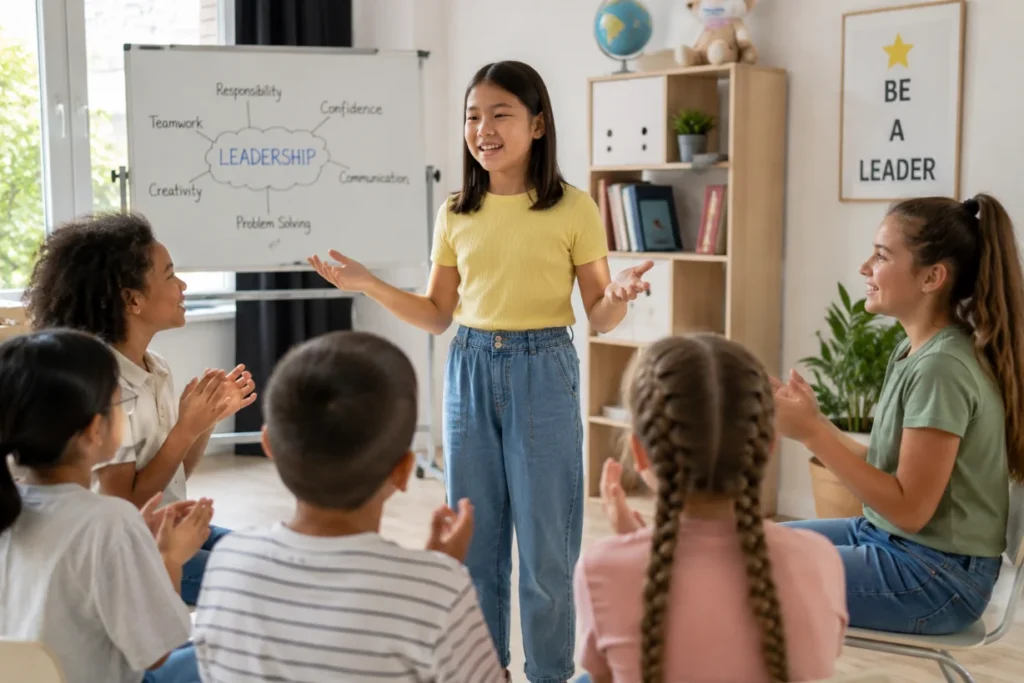
Leadership skills for kids today focus on empathy, communication, emotional regulation, and responsible decision-making instead of simply taking charge. Parents and educators can build these skills through age-appropriate experiences, everyday responsibilities, teamwork, and guided problem-solving, helping children become the strongest leaders in school, sports, and later in their careers.
Why Modern Leadership Looks Different
For many years, leadership was associated with confidence, public speaking, and directing a team. While these qualities still matter, children, now more than ever, are encouraged to understand different perspectives, regulate their emotions, and solve problems together as the base of their leadership skills.
Beyond the classroom, children regularly practice leadership through everyday routines, such as coordinating group assignments online, participating in gaming communities, creating digital content, or helping classmates complete shared projects.
These situations require communication, accountability, and digital responsibility, all of which are leadership skills.
Research continues to support the long-term value of developing these abilities early. According to the World Economic Forum, skills such as collaboration, resilience, analytical thinking, and leadership remain among the most valuable competencies for future careers.
Likewise, the Collaborative for Academic, Social, and Emotional Learning (CASEL) reports that social and emotional learning helps improve academic performance, relationships, and emotional well-being.
Instead of asking whether a child is “born a leader,” parents can focus on creating daily opportunities to practice leadership through conversations, responsibilities, and teamwork.
If you are looking for structured programs to build these foundational skills, platforms like MoneyKids offer specialized environments that guide children through real-world, interactive leadership scenarios.
Are Traditional Youth Leadership Models Outdated?
Traditional youth leadership models are not outdated, but they no longer reflect everything that makes a child an effective leader.
For many years, schools often looked for the student who was confident enough to speak in front of a class or take charge of a group. Those qualities still matter. But, some children naturally lead by paying close attention to others. They notice when a teammate is struggling, ask thoughtful questions, and help the group move forward without needing to be the loudest person in the room.
Leadership has also changed because children spend part of their lives in digital spaces, where many friendships are built online. Every interaction gives children a chance to learn how their words affect other people. Making responsible choices online has become another way they build leadership, even if they never hold a formal leadership title.
The same shift can be seen in today’s workplace. The World Economic Forum reports that employers increasingly value people who can adjust when situations change instead of relying on a fixed way of working. Technical knowledge is still important, but so is the ability to work through challenges with other people and keep learning over time.
Instead of asking, “Who is the loudest?” parents and educators can start asking, “Who earns the trust of others?” That simple change opens the door for many different leadership styles to develop, giving every child the opportunity to grow into a leader in their own way.
10 Essential Leadership Skills for Kids to Master
Leadership is built through small habits that children practice over time. They develop leadership every time they make a thoughtful decision, take responsibility for a task, or help someone else succeed.
1. Active Listening and Perspective-Taking
Active listening helps children understand people before trying to be understood themselves.
Children often want to respond quickly because they are excited to share their own thoughts. Learning to slow down and listen changes the conversation completely. They begin to notice how someone else feels, what the problem really is, and where misunderstandings come from.
Parents can encourage this during everyday conversations. If a sibling shares a story, ask the other child to explain what they heard before giving their own opinion. It sounds simple, but this habit teaches children to value another person’s perspective instead of focusing only on their own.
2. Emotional Regulation
Emotional regulation teaches children how to manage themselves before trying to influence anyone else.
Every child feels frustrated, disappointed, or overwhelmed from time to time. While those emotions are normal, it’s important to slowly teach them how to respond in that moment.
Parents can help children name what they are feeling and give themselves time to settle down. A few quiet minutes after an argument or a difficult game often leads to better decisions than reacting while emotions are still running high.
Research from CASEL, a leading organization in social and emotional learning, shows that children who develop these skills often perform better in school while building healthier relationships.
3. Critical Thinking and Independent Decision-Making
Critical thinking helps children become comfortable making decisions without waiting for someone else to provide the answer.
It can be tempting to step in whenever a child faces a difficult choice. Sometimes, however, asking a question is better than giving advice.
If a child cannot decide how to spend their allowance or organize a school project, encourage them to think through the possible outcomes. They may not choose perfectly every time, but they will learn how to weigh different options and become more confident in their own judgment.
4. Inclusivity and Empathy-Driven Collaboration
Empathy allows children to bring people together, even when everyone has different ideas.
Some children naturally notice when a classmate is left out or when someone seems uncomfortable joining a group. Acting on those observations is a quiet form of leadership.
Parents can reinforce this by talking about situations from daily life. Instead of asking whether their child had fun at school, they might ask if anyone seemed lonely during recess or whether someone needed help during class. These conversations help children look beyond themselves and pay closer attention to the people around them.
When children learn to include others, they create environments where everyone feels comfortable contributing.
5. Radical Accountability and Chore Ownership
Accountability grows when children experience the satisfaction of owning a responsibility from beginning to end.
Parents can integrate this through chores. Household chores are often seen as a way to keep the home tidy, but they also teach children that other people rely on them.
Giving a child full ownership of one meaningful responsibility, whether feeding a pet or setting the dinner table each evening, encourages independence. Parents can resist the urge to remind them constantly. Missing a task once in a while also becomes part of the learning process.
6. Adaptive Problem-Solving
Adaptability helps children move forward when things do not go according to plan.
Every child will eventually face disappointment. A sports match gets cancelled, a science experiment fails, or a friend changes the rules of a game. While these moments can be frustrating, they also create opportunities to practice flexibility.
Parents can model this by thinking out loud when plans change. Rather than focusing on what went wrong, they can show how to look for another solution. Children quickly learn that setbacks are often temporary, and that changing direction is part of solving problems.
7. Respectful Negotiation and Compromise
Negotiation helps children solve disagreements without turning every situation into a competition.
Children negotiate far more often than adults realize. They decide whose turn comes first during a game, where the family should eat, or how to divide responsibilities for a school project. These moments teach them that getting their own way is not always the best outcome.
Parents do not need to settle every disagreement. When the situation is safe, allowing children to work through a small conflict gives them the chance to explain their thinking, listen to another point of view, and find a solution they can both accept. Those conversations are often messy at first, but they become easier with practice.
8. Resilience and a Growth Mindset Toward Failure
Resilience helps children recover from setbacks without letting one mistake define them.
Every child experiences disappointment. They might forget their lines during a performance, lose an important match, or receive a lower grade than expected. While these moments can feel discouraging, they also shape how children respond to future challenges.
Parents can support resilience by paying attention to what happened after the setback. Did the child try again? Did they change their approach? Those moments deserve as much recognition as the final result.
Psychologist Carol Dweck has spent decades studying how children respond to challenges. Her research shows that children who believe abilities can improve through effort are generally more willing to keep learning after making mistakes.
Learn more about growth mindset from Mindset Works.
9. Articulate Communication, Verbal and Non-Verbal
Clear communication helps children express their ideas in a way that others understand.
Speaking confidently is only one part of communication. Children also learn through everyday habits such as making eye contact, waiting for the right moment to speak, and paying attention to how someone reacts.
One of the easiest ways to build this skill is by involving children in family conversations. Asking them to explain why they chose a particular answer or how they solved a problem encourages them to organize their thoughts before speaking. Over time, they become more comfortable sharing ideas in classrooms, group projects, and unfamiliar situations.
Good communicators do not always speak the most. They know how to make their message clear and help others feel included in the conversation.
10. Responsible Digital Stewardship
Children need digital leadership because part of their—and our—social life now happens online.
Whether they are chatting with classmates, playing multiplayer games, or working on a shared assignment, children leave a digital footprint with every interaction. Learning how to communicate respectfully online is becoming as important as learning good manners in person.
Parents can treat online behavior as an extension of everyday values rather than a separate topic. Before posting a comment or sending a message, children can be encouraged to pause and think about how another person might read it. This habit helps them avoid unnecessary conflict while building a reputation for being thoughtful and respectful.
Guidance from Common Sense Media offers practical advice for helping children develop safe and responsible digital habits.
Age-by-Age Blueprint, Cultivating Leaders from Toddlers to Teens
Leadership develops in stages, and children benefit most when expectations match their age and level of independence.
A toddler learns leadership very differently from a teenager. Younger children need opportunities to make simple choices and build confidence. As they grow, they become ready for greater responsibility, bigger decisions, and experiences that affect people beyond their own family. Matching these opportunities to a child’s development makes leadership feel natural instead of forced.
Early Childhood: Ages 3 to 6
Young children build leadership by making simple choices and learning that their decisions matter.
Parents do not need elaborate activities to encourage leadership at this age. Everyday routines already provide plenty of opportunities. Choosing between two outfits, deciding which bedtime story to read, or helping prepare the table gives children a chance to make decisions within safe boundaries.
Play also becomes an important teacher. Building a tower that falls over or working out how to share toys introduces young children to problem-solving without feeling like a lesson. During these moments, parents can help children put words to their emotions instead of solving every problem for them.
Small choices made consistently help children become more willing to take initiative as they grow.
Middle Childhood: Ages 7 to 11
Children between seven and eleven learn leadership best by working with other people.
Group activities naturally expose children to different personalities. A sports team, music ensemble, scout troop, or school club gives them opportunities to contribute, encourage teammates, and experience different leadership styles. They also discover that every member plays a role, even when they are not the captain.
Parents can support this growth by stepping back when minor disagreements happen. If children are safe, there is often value in letting them work through playground conflicts or group decisions on their own. Solving these situations independently builds confidence that cannot be taught through advice alone.
Adolescents and Teens: Ages 12+
Teenagers develop leadership by taking ownership of projects that have a meaningful impact.
As children enter adolescence, they are ready for responsibilities that extend beyond their immediate circle. Organizing a neighborhood clean-up, planning a fundraising event, or mentoring younger students gives them a chance to lead while seeing how their efforts benefit other people.
School also becomes an important place to practice self-advocacy. Speaking with a teacher about a concern, organizing a study group, or proposing an idea for a school activity teaches teenagers that leadership often begins with taking initiative.
Research from the Search Institute has consistently shown that young people thrive when they are trusted with meaningful roles and supported by caring adults. Giving teenagers room to contribute prepares them for the greater independence that comes with adulthood.
5 Subtle Parenting Mistakes That Could Stifle Leadership
Parents naturally want to protect their children and help them succeed. But some well-intentioned parenting habits can sometimes slow their growth. The challenge comes when support turns into taking over. Give children room to make decisions, experience setbacks, and learn from the outcome.
1. Solving Every Problem Before They Can Try
Children become better problem-solvers when they have the chance to work through small challenges on their own.
It is tempting to step in the moment a child struggles with homework, argues with a friend, or forgets something important. While helping is sometimes necessary, stepping in too quickly can send the message that someone else will always fix the problem.
Instead, give them time to think. A simple question like, “What do you think you could try next?” often does far more than offering the answer immediately.
2. Praising Results Instead of the Process
Winning a competition or earning high marks feels exciting, but those moments only tell part of the story. The preparation, persistence, and willingness to improve deserve attention too.
For example, instead of saying, “You did a great job because you won,” try pointing out what helped them succeed. Maybe they stayed focused during practice or kept going after making a mistake. This encourages children to see growth as something they can influence, rather than something they either have or do not have.
3. Filling Every Hour With Activities
Children also need free time to discover what they can do without constant direction.
A full schedule may expose children to many opportunities, but it leaves little room for independence. Unstructured play encourages them to invent games, settle disagreements, and make decisions without relying on adults to organize every detail.
Those moments often reveal leadership in its simplest form. One child suggests an idea, another builds on it, and together they find a way to make it work.
Balance matters. A few meaningful activities often provide more value than a calendar packed from morning to evening.
4. Protecting Children From Every Failure
Small setbacks help children develop confidence because they learn they can recover from them.
Forgetting homework, missing a deadline, or losing a game can feel disappointing. They are also valuable learning experiences.
Parents do not need to remove every obstacle. Allowing children to experience manageable consequences teaches responsibility far better than repeated reminders. The lesson usually stays with them because they discovered it themselves.
Over time, children begin to trust their own ability to recover when things do not go as planned.
5. Mistaking Obedience for Leadership
A well-behaved child is not always learning how to lead.
Following instructions is an important life skill, but leadership also involves thinking independently and speaking up respectfully. Children should feel comfortable asking questions, offering ideas, or disagreeing politely when appropriate.
Creating space for these conversations at home helps children develop confidence in expressing themselves. They learn that respect and independent thinking can exist together, rather than feeling they must choose one or the other.
3 Leadership Games to Play at Home
Simple activities often teach leadership better than formal lessons because children learn by doing. These ideas require very little preparation and fit naturally into everyday family life.
The Blindfolded Architect
One child gives instructions while another builds a simple structure using blocks or household objects without being able to see the finished design.
The goal is to practice giving clear instructions, listening carefully, and adjusting when something goes wrong.
The Family Budget Challenge
Give your child a fixed budget for a weekend activity and let them plan how to spend it.
They might compare ticket prices, calculate transport costs, or decide whether bringing snacks from home creates room for another activity. Parents can guide the discussion without taking over the decisions.
This activity encourages thoughtful planning while showing that every choice comes with trade-offs.
Give One Chore Complete Ownership
Choose one household responsibility and let your child manage it from start to finish.
Avoid frequent reminders unless they ask for help. Whether it is feeding a pet, watering the plants, or preparing the table before dinner, complete ownership builds a stronger sense of responsibility than constantly being supervised.
Frequently Asked Questions
Can introverted kids develop strong leadership skills?
Of course! Many introverted children become effective leaders because they observe carefully before acting. They often build trust by listening well and thinking through problems instead of reacting quickly. Leadership depends far more on how a child influences others than on how much they enjoy being the center of attention.
What is the difference between a bossy child and a leader?
A bossy child focuses on getting their own way. A leader focuses on helping the group succeed.
Children who lead well consider other people’s ideas, explain their thinking clearly, and accept responsibility when something goes wrong. They influence through respect rather than control.
How can programs and physical activities build a child’s confidence?
Dedicated programs give children opportunities to make decisions outside their usual routine. Working with new teammates, learning unfamiliar skills, and overcoming small challenges all help build confidence over time.
Physical activities also teach lessons that extend beyond fitness. Children discover how to handle setbacks, encourage teammates, and keep improving even when progress feels slow.
Experiential programs, such as the MoneyKids Entrepreneur Bootcamp, serve as excellent short-term programs great for honing kids’ leadership skills, critical thinking, and collaborative abilities while accelerating their personal confidence.
How do you teach leadership to a child who gives up easily?
Start with challenges that are difficult enough to require effort but still achievable.
When children experience small successes after working through a problem, they begin to see that persistence makes a difference. Parents can support this by recognizing the progress they made along the way rather than focusing only on the final outcome.
Over time, children become more willing to try again because they have evidence that effort leads to improvement.