
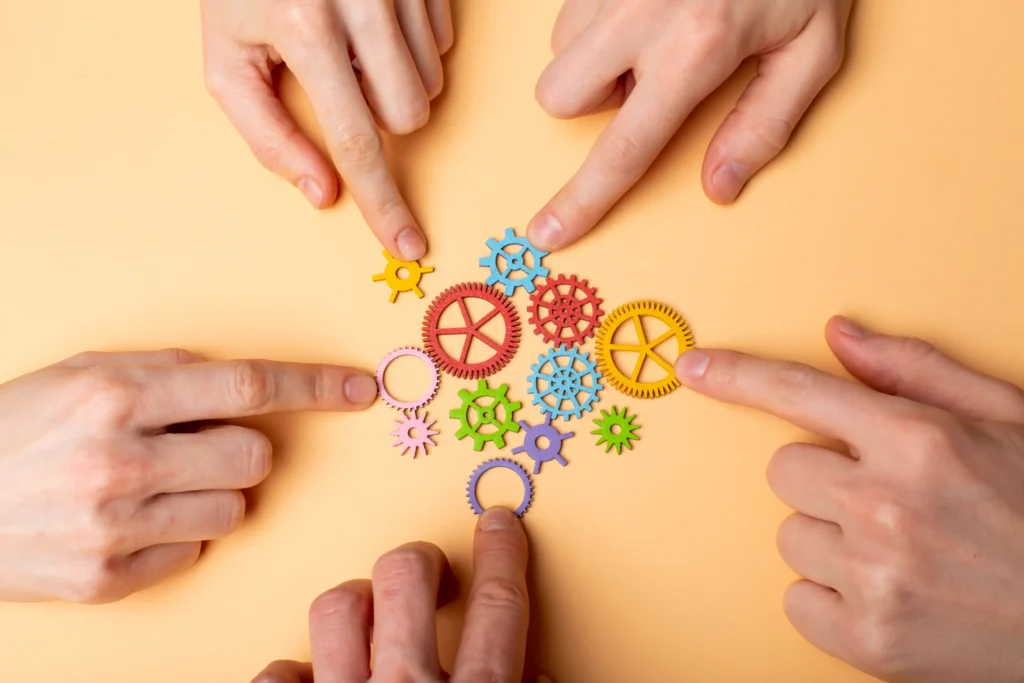
Soft skills are personal and interpersonal abilities that influence how children express themselves, work with others, and make decisions.
Research has also drawn attention to their role in children’s development. The OECD’s 2023 Survey on Social and Emotional Skills found that students with stronger social-emotional skills tended to achieve better academic results and report greater well-being.1 Of course, these skills develop gradually, and a child who excels in one area may still need time to develop another.
Play and storytelling offer children a way to explore these abilities in an engaging setting. At MoneyKids, children enter a fictional world where characters face challenges involving money and business. They take part in finding solutions, developing business ideas, creating brands, and pitching their concepts to help the characters reach their goals.
The activities bring soft skills into a context children can understand and participate in. Here are 10 skills children can begin developing through these experiences.
(1) Communication
We often think of communication as the ability to speak well. However, being able to express an idea is only one part of the process. Children also need to organise their thoughts, listen to what others are saying, and recognise when their message hasn’t come across as intended.
Good communication gives children a way to share their views and understand different perspectives. It also forms part of many other soft skills, including teamwork, negotiation, and leadership. The ability to speak confidently is a start, but learning to listen is just as important.
(2) Teamwork and collaboration
Working in a group can be harder than it looks. Everyone brings their own preferences, and agreeing on a shared direction requires children to look beyond what they want individually.
Teamwork involves contributing towards a common goal, while collaboration focuses on bringing different ideas and abilities together. Children can develop both by learning to respect other people’s contributions and recognising that their own approach may not always be the best fit for the group.
This doesn’t mean children have to agree with everyone. In fact, learning to work through differences is part of what makes collaboration a skill worth developing.
(3) Leadership and initiative
Leadership is often associated with being in charge, but children don’t need a formal role to begin developing it. At its core, leadership involves taking responsibility, influencing the direction of a group, and helping people work towards a shared goal.
Initiative is closely related. It describes the willingness to act when something needs to be done, rather than always waiting for instructions.
Children who develop these abilities can learn to take ownership of their contributions while remaining open to other people’s ideas. After all, leadership isn’t simply about getting others to follow your decisions. It also involves knowing when to listen and reconsider your own approach.
(4) Critical thinking and problem-solving
Children are naturally curious, but asking questions is only the beginning of critical thinking. The next step is learning to examine an idea, consider the available information, and decide whether the reasoning behind it makes sense.
Problem-solving builds on this ability. It involves working out what needs to change, which options are worth considering, and how to move forward when the first attempt doesn’t work.
These skills help children become more deliberate thinkers. Instead of accepting the first answer they hear or settling on the easiest option, they can learn to consider why one approach might work better than another.
(5) Decision-making
Making decisions means choosing between options, often when each has its own advantages and disadvantages. For children, this skill develops as they learn to think beyond their immediate preferences and consider what they hope to achieve.
Decision-making also involves accepting that choices have consequences. Not every decision will produce the intended result, and children won’t always know which option is best. What they can learn is how to weigh their priorities, think through the possible outcomes, and reflect on their choices afterwards.
Over time, this process can help children become more deliberate about the decisions they make.
(6) Negotiation and conflict resolution
Disagreements are a normal part of interacting with other people. The challenge is learning how to handle them without assuming that one person must win and the other must lose.
Negotiation involves discussing different interests and looking for an agreement. Conflict resolution focuses on addressing the disagreement itself, including the feelings and concerns behind it.
Both skills require children to consider perspectives beyond their own. They also need to learn that compromise doesn’t always mean getting everything they want. Sometimes, reaching an agreement involves finding an option that everyone can accept, even if it isn’t anyone’s first choice.
(7) Creativity
Children are often willing to imagine possibilities that adults might dismiss too quickly. That willingness to explore different ideas is an important part of creativity.
Creativity isn’t limited to drawing, music, or other artistic activities. It also involves generating new ideas, looking at familiar problems differently, and considering alternatives that aren’t immediately obvious.
There is a balance to strike, though. Generating ideas is one part of the process; evaluating and refining them is another. When children have room to experiment without being judged too quickly, they can practise both the imaginative and practical sides of creative thinking.
(8) Adaptability
Plans change, expectations shift, and sometimes an approach simply doesn’t work. Adaptability is the ability to respond to these changes rather than becoming stuck on the original plan.
This skill is closely related to cognitive flexibility, which allows people to adjust their thinking when circumstances or perspectives change. Harvard’s Center on the Developing Child identifies cognitive flexibility as one component of executive function, alongside working memory and inhibitory control.
For children, adaptability involves learning to consider another approach when needed. It doesn’t mean they must be comfortable with every change. Rather, they can gradually learn to work through their initial reaction and decide what to do next.
(9) Responsibility and self-management
Responsibility involves recognising one’s commitments and taking ownership of one’s actions. Self-management goes a step further by helping children regulate their behaviour, maintain attention, and follow through on what they intend to do.
These abilities develop over time. Harvard’s Center on the Developing Child explains that executive function and self-regulation skills are not fully formed at birth; children build them through experience and practice.
As children grow, they can gradually take on more responsibility for their own tasks and decisions. The aim isn’t to expect them to manage everything independently at a young age, but to give them room to build these abilities at a pace that suits their development.
(10) Financial judgement
Financial judgement is the ability to make considered choices about money. It involves understanding priorities, weighing trade-offs, and thinking about how a financial decision may affect future plans.
Children can begin learning about money through basic concepts such as earning, spending, and saving. As their understanding grows, they can explore how businesses earn revenue, why people borrow money, and what investing involves.
These topics introduce more complex decisions that connect financial knowledge with critical thinking and self-management.
For parents who want to introduce the next level of money concepts, our guide to teaching investing to children explains how to approach the topic in age-appropriate ways.
At the MoneyKids Financial Literacy Bootcamp, children can explore topics such as earning, saving, investing, currencies, loans, and giving back through play-based learning. This gives them a starting point for discussing how financial choices work and why different decisions can lead to different outcomes.
How Do Soft Skills Help Children in Everyday Life?
Soft skills are sometimes discussed as preparation for adulthood, but children already use them in their daily lives. They come into play when a child works on a school assignment, tries to make friends, or has to deal with disappointment.
One area where these skills become particularly noticeable is in relationships. A child who can listen to another person’s point of view may find it easier to work through disagreements. A child who can express their feelings and explain what they need has a better starting point for resolving misunderstandings.
Soft skills also shape how children approach learning. Curiosity encourages them to ask questions, while critical thinking helps them examine what they learn. When an answer turns out to be wrong, adaptability allows them to reconsider their approach instead of giving up immediately.
There is also a connection between social-emotional skills and children’s well-being. The OECD’s Social and Emotional Skills for Better Lives report found that students with lower levels of these skills tended to report poorer well-being outcomes. The findings highlight why children’s social and emotional development deserves attention alongside academic learning.
What parents can do to help is giving them room to practice these abilities in everyday situations, with age-appropriate expectations and opportunities to learn from what happens.
How Can Play and Storytelling Help Children Practice Soft Skills?
Children can learn about a skill by hearing it explained, but play gives them a chance to put it into action. When a game involves rules, choices, or other players, children have to use their thinking and behaviour to take part.
Research from Harvard’s Center on the Developing Child describes play as one way children can practise executive function skills, including attention, working memory, and self-control.
These abilities develop over time through experience and practice, rather than appearing fully formed at a particular age.
Storytelling adds another dimension because it gives children a situation to think about. Children can consider what the character should do, discuss different possibilities, and think about what might happen after each decision. The story gives their thinking a purpose, rather than asking them to learn a skill in isolation.
At MoneyKids, children take part in a fictional storyline where characters encounter challenges involving money and business. They work on business ideas, develop brand names and logos, brainstorm with other children, and pitch their ideas to help the characters reach their goals. The activities bring several soft skills together within the same experience.
How Can Parents Help Children Practise Soft Skills at Home?
Here are a few ways parents can encourage these skills at home.
- Let children take part in decisions. Invite them to explain their preferences and weigh different options instead of making every choice for them. This gives children practice in expressing their opinions and thinking through the reasons behind a decision.
- Give them room to solve small problems. When children encounter a manageable difficulty, resist the urge to step in with an immediate answer. Ask what they think they could try first. They may still need some help, but working towards a solution gives them a chance to practise independent thinking.
- Make time for play. Board games involve turn-taking, following rules, and making decisions. Pretend play lets children invent ideas and negotiate roles. These activities can encourage children to practise social and thinking skills without making the experience feel like a formal lesson.
- Give children age-appropriate responsibilities. Let them take ownership of a small task or contribute to a shared family activity. Following through on a commitment helps them practise responsibility and learn how their actions affect others.
- Talk through setbacks together. When something doesn’t go as planned, help children reflect on what happened and what they might try differently. Rather than expecting them to handle disappointment perfectly, give them time to work through their feelings and consider their options.
The skills that help children lead, decide, and get along with others show up every day in playground talks, classroom projects, and family life. Play and storytelling just give those skills a clearer stage.
At MoneyKids, kids step into a story with money and business problems to solve, practising communication, adaptability, initiative, and thoughtful choices along the way. Parents can support the same growth by inviting children into decisions, leaving room for trial and error, and talking through setbacks instead of fixing them right away. The goal is not perfection, but steady practice in a place where kids feel safe enough to keep trying.
Frequently Asked Questions
What are the most important soft skills for kids?
Communication, teamwork, critical thinking, decision-making, and self-management are among the key soft skills children can begin developing early. No single skill works in isolation. Children often draw on several at once when working with others, solving a problem, or managing a difficult situation. The skills they need to practise most will depend on their age, experiences, and individual needs.
At what age should children start learning soft skills?
Children can begin developing soft skills from an early age through play and everyday interactions. The complexity of what they can manage changes as they grow. Younger children may start with turn-taking and expressing their needs, while older children can gradually work on more involved decisions, group responsibilities, and resolving disagreements. There is no single age when all these abilities should be fully developed.
How can parents teach soft skills at home?
Parents can create opportunities for children to make age-appropriate decisions, contribute to family activities, and work through small problems. Asking children to explain their reasoning can encourage thoughtful decision-making, while giving them time to resolve manageable disagreements can help them practise communication and negotiation. The aim is to let children participate rather than expecting them to get everything right immediately.
Can storytelling help children develop leadership skills?
Storytelling can give children a setting in which to explore leadership. When characters face challenges, children can discuss possible solutions, consider different points of view, and think about what makes a decision effective. Interactive storytelling takes this further by letting children contribute their own ideas and work towards a shared goal. These activities offer opportunities to explore leadership, although they do not guarantee that a child will become a confident leader.
How does play-based financial literacy help children develop soft skills?
Play-based financial literacy introduces money concepts through activities that involve choices and consequences. As children explore earning, saving, spending, or business ideas, they can also practise weighing options, explaining their decisions, and working with others. At MoneyKids, financial and entrepreneurship concepts are explored through a fictional storyline and interactive activities, giving children a context for discussing both money and the decisions surrounding it.
What is the difference between soft skills and life skills?
Soft skills generally refer to personal and interpersonal abilities, such as communication, teamwork, adaptability, and leadership. Life skills is a broader term for abilities that help people manage everyday situations, which may include practical tasks, financial literacy, personal safety, and decision-making. The categories overlap. For example, managing an allowance involves financial knowledge as well as decision-making and self-management.